Imagine you and four friends build a ticket booking site for your college fest. It works perfectly on your laptop. On the day tickets go live, three thousand students open it at once and it crashes in two minutes.
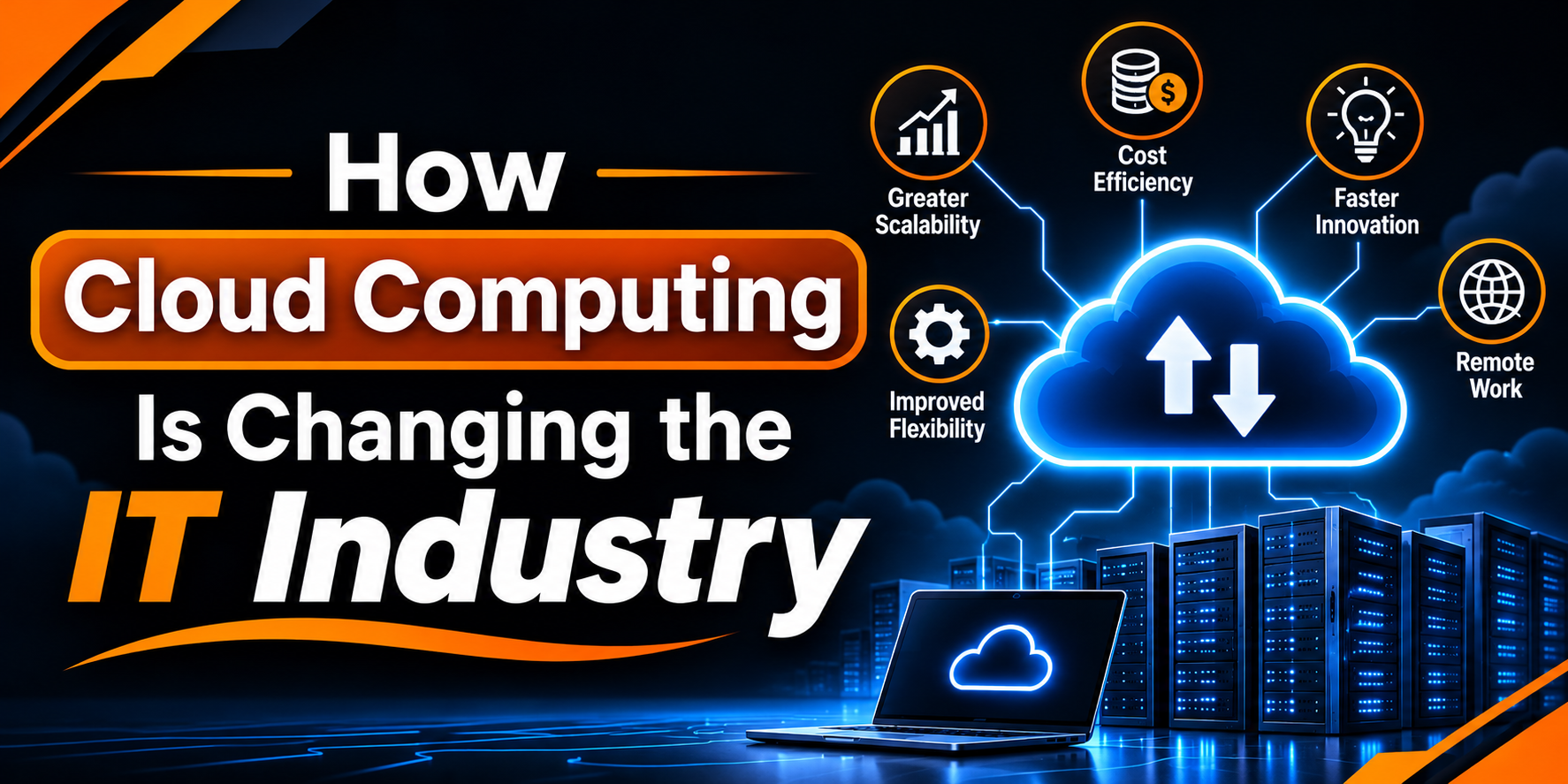
Ten years ago, fixing that meant buying or renting physical servers, waiting for delivery and hoping you guessed the capacity right. Today you can rent more computing power in minutes and give it back when the rush ends. That one change, renting instead of owning, explains most of what cloud computing has done to the IT industry.
This guide is for students and beginners who want to understand the impact of cloud computing on the IT industry, why it matters to businesses and what it means for your career.
The Three Service Models You Must Know
Almost every cloud conversation uses three terms. Learn them once and the rest gets easier.
| Model | What you get | Everyday example | Who manages the operating system? |
|---|---|---|---|
| IaaS (Infrastructure as a Service) | Virtual machines, storage, networks | Amazon EC2, Azure Virtual Machines | You |
| PaaS (Platform as a Service) | A ready platform to run your code or database | Google App Engine, Azure App Service | The provider |
| SaaS (Software as a Service) | A finished application | Gmail, Google Docs, Microsoft 365 | The provider |
Think of it like food. IaaS is buying groceries and cooking for yourself. PaaS is a meal kit. SaaS is ordering a finished dish.
How Cloud Computing Is Transforming IT Infrastructure and Services
The biggest shift is not technical. It is financial and organizational.
| Area | Before cloud | With cloud |
|---|---|---|
| Buying hardware | Large upfront purchase | Pay as you use |
| Getting a server | Weeks | Minutes |
| Capacity planning | Guess the peak and buy for it | Scale up and down as needed |
| IT team focus | Racking servers, patching hardware | Automation, security, architecture |
| Disaster recovery | A second data center, very costly | Replicate across regions |
From owning to renting
A company that used to run its own server room now rents capacity from providers like AWS, Microsoft Azure or Google Cloud. The provider handles buildings, power, cooling and physical security. Your team handles what runs on top.
From manual setup to code
Because cloud resources are created through APIs, engineers describe infrastructure in files (called Infrastructure as Code) instead of clicking through screens. Tools like Terraform and AWS CloudFormation do this. It means setup can be reviewed, versioned in Git and repeated exactly.
A hypothetical example: the first ticket site
This is a made-up scenario to show the logic, not a reported case.
- Problem: Traffic is tiny for 29 days and huge for one hour.
- Solution: Run the site on a cloud platform with auto scaling.
- How it works: A load balancer spreads visitors across several servers. When load rises, the platform adds servers automatically. When it falls, it removes them.
- Benefit: You pay for the busy hour, not for a year of idle machines.
- Limitation: If your database is the bottleneck, adding web servers will not help. Scaling needs design, not only a bigger bill.
A Small Hands-On Example: Storing and Sharing a File
Reading about the cloud only goes so far. Here is a short Python script using boto3, the official AWS SDK for Python. It uploads a file to Amazon S3 (object storage) and creates a temporary download link.
import boto3
from botocore.exceptions import ClientError

# Credentials come from your AWS profile or an IAM role.
# Never hardcode access keys in source code.
s3 = boto3.client("s3")

BUCKET_NAME = "my-student-notes-bucket"  # bucket names must be globally unique


def upload_and_share(local_path: str, object_key: str) -> str | None:
    """Upload a file to a private bucket and return a link valid for 1 hour."""
    try:
        s3.upload_file(local_path, BUCKET_NAME, object_key)
        url = s3.generate_presigned_url(
            "get_object",
            Params={"Bucket": BUCKET_NAME, "Key": object_key},
            ExpiresIn=3600,  # seconds
        )
        return url
    except ClientError as error:
        # Typical causes: wrong bucket name, missing permission, no credentials
        print(f"Upload failed: {error}")
        return None


if __name__ == "__main__":
    link = upload_and_share("report.pdf", "notes/report.pdf")
    print(link)
What it teaches: The bucket stays private and only the temporary link grants access. That is a basic example of cloud security done right. Check your provider's current free tier terms before running anything, since offers change.
Why Cloud Computing Is Important for Businesses
Cloud computing benefits for businesses look different depending on size, so it helps to compare.
Benefits of cloud computing for small and large businesses
| Business type | What cloud mainly gives them | Typical concern |
|---|---|---|
| Startup or small business | No upfront hardware cost, fast launch, access to tools once reserved for big firms | Surprise bills as usage grows |
| Mid-size company | Easier remote work, managed databases, backups | Choosing between providers |
| Large enterprise | Global reach, disaster recovery, AI infrastructure | Governance across many accounts and clouds |
Gartner's India analysis points to that last problem. Governance of increasingly complex hybrid, multicloud and AI-enabled environments is emerging as one of the most significant cloud challenges for enterprises in 2026.
The short answer to "why is cloud computing important for businesses" is speed. A team that can test an idea in a week instead of a quarter learns faster and wastes less.
The Part Beginners Usually Miss: Security Is Shared
Many students assume the cloud provider handles all security. It does not. AWS documents this as the Shared Responsibility Model.
Customers are responsible for managing their data, including encryption options, classifying assets and using IAM tools to apply the right permissions. The provider secures the physical data centers and the underlying platform. You secure what you put on it.
The amount you manage also shrinks as services become more abstract. AWS guidance explains that with serverless services nearly all of the security responsibility belongs to AWS, and your concern is mainly securing access to data through encryption and authentication.
In practice, most beginner mistakes are on the customer side: a storage bucket left public, a password committed to GitHub, or an account with far more permissions than it needs. Learn IAM (identity and access management) early. It pays off in every cloud.
The Costs Nobody Puts in the Brochure
Cloud is flexible, but flexibility can be expensive when nobody watches it. Flexera's 2026 report found that estimated wasted cloud spend on IaaS and PaaS is 29%, reversing a five-year downward trend. That means a large share of money goes to resources that are oversized, idle or forgotten.
Other trade-offs worth knowing:
- Vendor lock-in. Services built on one provider's special features are harder to move.
- Data transfer fees. Moving data out of a provider can cost more than storing it.
- Skill gaps. Easy to start does not mean easy to design well.
This is why a discipline called FinOps (managing cloud cost as a team habit) is growing. Even a student project benefits from setting a billing alert on day one.
Cloud Computing Trends 2026
Based on current analyst and survey data, these trends matter most right now.
1. AI is pulling cloud spending toward infrastructure. Gartner's 2026 forecast notes that AI-driven demand for high-performance cloud infrastructure is reshaping spending priorities, with IaaS leading growth as enterprises scale inference workloads. In India specifically, IaaS is projected to grow 40% in 2026 and PaaS 25.4%, with PaaS the largest spending category at $6.4 billion.
2. Generative AI is now ordinary cloud usage. In Flexera's data, all survey respondents report using GenAI in some capacity and 45% use it extensively.
3. Hybrid and multi-cloud are the normal state. Running some workloads in a private environment and others across several public clouds is no longer unusual, as the 73% and 88% figures above show.
4. Governance and cost control matter as much as migration. Companies now ask whether cloud delivers measurable value, not only whether workloads moved.
Sovereign cloud (keeping data under local legal control) and serverless computing are also getting more attention in analyst commentary, so they are worth reading about if you want to go deeper.
How Cloud Computing Is Changing IT Jobs
Cloud does not remove IT jobs. It changes what the work is. Atlassian notes that roles such as solutions architect and enterprise architect, which stitch together external cloud services to meet business needs, become especially important in a cloud transition.
What are the career opportunities in cloud computing?
A recruitment firm's 2026 guide lists cloud architects, DevOps engineers, site reliability engineers, cloud security specialists, data engineers and FinOps analysts among top roles in India. Here is what each does in simple terms.
| Role | What you actually do | Good first skills |
|---|---|---|
| Cloud Engineer | Build and maintain cloud environments | Linux, networking, one cloud platform |
| DevOps Engineer | Automate building, testing and deploying software | Git, CI/CD, Docker, scripting |
| Cloud Security Engineer | Protect accounts, data and networks | IAM, encryption, monitoring |
| Data Engineer | Move and prepare data for analysis | SQL, Python, cloud storage |
| Solutions Architect | Design the overall cloud setup for a business | Broad cloud knowledge, communication |
| FinOps Analyst | Track and reduce cloud spend | Billing tools, basic finance sense |
Cloud computing skills and jobs in demand in India
I did not find a primary source for the often repeated "millions of cloud jobs" projections, so I am not quoting a number. What is safe to say is that cloud sits next to AI, data and cybersecurity in skills lists that employers and skill reports mention. Spending growth like Gartner's India forecast also suggests continuing hiring needs, though a forecast is not a guarantee of jobs.
A realistic beginner path
- Learn the basics. Linux commands, how networks and IP addresses work, and one language such as Python.
- Pick one provider. AWS, Azure and Google Cloud all teach the same concepts. Depth in one beats shallow knowledge of three.
- Build small things. A static website on object storage, a small API on a serverless function, a database with backups.
- Add a certification if it helps. Entry level certifications from the providers give structure, but projects on GitHub show real skill.
- Learn cost and security habits early. Billing alerts and least privilege access separate a careful beginner from a risky one.
Key Takeaways
- Cloud computing changed IT from owning hardware to renting capacity and automating it.
- Startups gain speed and low entry cost. Large companies gain reach and resilience. Both must manage cost and governance.
- Security is shared. The provider secures the platform and you secure your data and access.
- IT jobs are shifting toward automation, architecture, security and cost management.
- The best way to learn is to build something small and watch the bill.
FAQ
Q1. How is cloud computing changing the IT industry?
Ans. It moves companies from buying and maintaining hardware to renting services, speeds up delivery of software and shifts IT roles toward automation, security and architecture.
Q2. What are the three main types of cloud services?
Ans. IaaS gives you virtual infrastructure, PaaS gives you a platform for your code and SaaS gives you finished software.
Q3. Is cloud storage safe?
Ans. It can be very safe, but safety depends on how you configure it. Under the shared responsibility model, you control permissions and encryption choices for your data.
Q4. Do small businesses really benefit from the cloud?
Ans. Yes, mainly through lower upfront cost and faster setup. They should still set budgets and alerts to avoid unexpected bills.
Q5. Which cloud platform should a beginner learn first?
Ans. Any of AWS, Azure or Google Cloud works. Pick the one most used in jobs near you or by your college, then go deep.
Q6. Can I start a cloud career without a computer science degree?
Ans. Many people enter through support, system administration or self-built projects, but employers differ. Practical projects and fundamentals in Linux, networking and scripting help a lot.
About the author
- 𝐓𝐈𝐒𝐀‑𝐓𝐄𝐂𝐇 is an 𝐀𝐈-𝐩𝐨𝐰𝐞𝐫𝐞𝐝 𝐭𝐫𝐚𝐢𝐧𝐢𝐧𝐠 𝐢𝐧𝐬𝐭𝐢𝐭𝐮𝐭𝐞 that helps students learn modern technologies in a simple and practical way. Our goal is to make learning easy and prepare you with job ready skills. 📚𝐖𝐡𝐚𝐭 𝐖𝐞 𝐎𝐟𝐟𝐞𝐫 We provide six AI powered courses that cover today’s most important skills: 𝐀𝐈 𝐚𝐧𝐝 𝐌𝐚𝐜𝐡𝐢𝐧𝐞 𝐋𝐞𝐚𝐫𝐧𝐢𝐧𝐠 🤖 𝐅𝐮𝐥𝐥 𝐒𝐭𝐚𝐜𝐤 𝐃𝐞𝐯𝐞𝐥𝐨𝐩𝐦𝐞𝐧𝐭 💻 𝐂𝐥𝐨𝐮𝐝 𝐂𝐨𝐦𝐩𝐮𝐭𝐢𝐧𝐠 ☁️ 𝐃𝐢𝐠𝐢𝐭𝐚𝐥 𝐌𝐚𝐫𝐤𝐞𝐭𝐢𝐧𝐠 📈 𝐆𝐫𝐚𝐩𝐡𝐢𝐜 𝐃𝐞𝐬𝐢𝐠𝐧𝐢𝐧𝐠 🎨 𝐔𝐈/𝐔𝐗 𝐃𝐞𝐬𝐢𝐠𝐧𝐢𝐧𝐠🖌️
Comments
Join the discussionNo comments yet. Be the first to comment.